
Executive Summary
In the subscription economy era, the traditional boundaries between product development and marketing have dissolved. While foundational marketing principles remain strategically relevant, their application must be reimagined for modern business realities: product-led growth models, AI-driven personalization, and continuous delivery cycles. This analysis examines how C-level executives can leverage integrated product-marketing frameworks to drive predictable revenue growth and sustainable competitive advantage.
The Revenue Integration Imperative
Beyond Departmental Silos
The most successful technology companies of the past decade such as Stripe, Notion or Figma didn't succeed by having great products or great marketing in isolation. They succeeded by creating integrated customer experience engines where product innovation and market strategy operate as unified systems. For C-level executives, this represents a fundamental shift from managing functional departments to orchestrating cross-functional revenue optimization.
The core strategic challenge is no longer whether your product team understands marketing principles, but whether your entire organization can deliver cohesive customer value throughout the entire lifecycle, from initial awareness through expansion revenue.
Reimagining Traditional Frameworks for Modern Business Models
The Customer Value Engine (Evolution of the 4Ps)
While the traditional 4Ps framework provides foundational structure, modern technology companies require a more sophisticated approach to customer value creation:
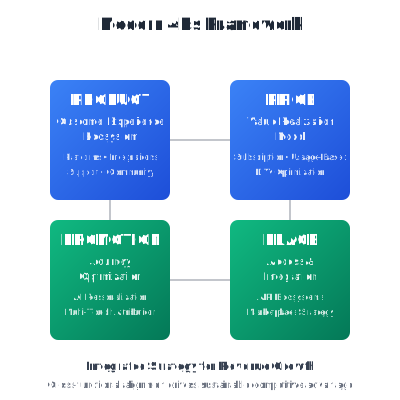
Product → Customer Experience Ecosystem
Modern products are rarely standalone solutions. They're platforms that enable customer success across multiple touchpoints. Instead of managing discrete product features, executives must orchestrate comprehensive customer experience ecosystems that include core functionality, integration capabilities, support infrastructure, and community engagement.
Price → Value Realization Model
Pricing strategy now encompasses subscription optimization, expansion revenue mechanics, and customer lifetime value maximization. The strategic question isn't "what should we charge?" but "how do we structure value realization to align our revenue growth with customer success?" This includes freemium conversion strategies, usage-based scaling, and enterprise value tiering.
Promotion → Customer Journey Optimization
Traditional promotional activities have evolved into sophisticated customer journey orchestration. This involves AI-driven personalization, product-led acquisition strategies, and integrated touchpoint management across marketing, product, and customer success functions.
Place → Access and Integration Strategy
Distribution strategy now encompasses API ecosystems, marketplace positioning, and integration partnerships. The strategic focus is on reducing friction to adoption while building network effects that increase customer stickiness.
Continuous Evolution vs. Linear Lifecycle
The traditional Product Life Cycle model assumes linear progression through discrete stages. Modern technology products exist in a state of continuous evolution, where multiple product lines and features exist simultaneously across different maturity stages.
Strategic Implications for Executives:
- Portfolio Management: Instead of managing single products through lifecycle stages, executives must optimize product portfolios where each component contributes to overall customer value and revenue growth.
- Resource Allocation: Investment decisions should be based on portfolio optimization rather than individual product lifecycle positioning.
- Innovation Pipeline: Successful companies maintain parallel innovation streams to ensure continuous value delivery while existing products evolve.
Strategic Segmentation, Targeting, and Positioning for Revenue Optimization
Beyond Demographics: Intelligence-Driven Market Strategy
While traditional STP focused on demographic and firmographic characteristics, modern technology companies require a fundamentally different approach to market segmentation and competitive positioning.
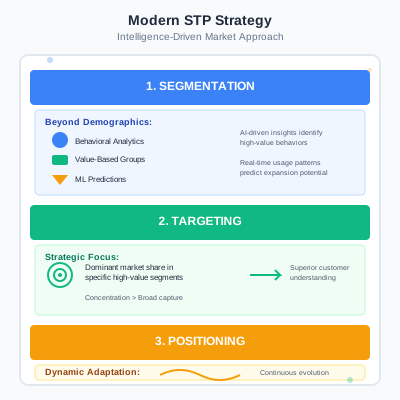
Contemporary Segmentation Strategy:
Modern segmentation leverages behavioral analytics, AI-driven insights, and real-time usage patterns to identify segments with the highest revenue potential. Instead of asking "who are our customers," successful companies ask "which customer behaviors predict long-term value creation?"
- Behavioral Segmentation: Analyzing product engagement patterns to identify expansion-ready accounts
- Value-Based Segmentation: Grouping customers by realized outcomes, not just company characteristics
- Predictive Segmentation: Using machine learning to identify accounts likely to expand, churn, or become advocates
Strategic Targeting for Market Dominance:
Rather than broad market capture, successful companies focus on achieving dominant market share within specific, high-value segments. This concentration strategy enables superior customer understanding, more efficient resource allocation, and stronger competitive moats.
Dynamic Positioning in Crowded Markets:
Traditional positioning was static. Modern positioning requires continuous adaptation based on competitive landscape changes, customer feedback loops, and market evolution. The most successful technology companies maintain positioning flexibility while preserving core value proposition clarity.
Implementation Imperatives
Organizational Integration
The primary challenge for C-level executives isn't conceptual understanding, it's breaking down functional silos to create unified customer value delivery:
- Unified Metrics: Establish shared KPIs that align product innovation with revenue objectives
- Customer Journey Ownership: Assign cross-functional teams to own specific segments or lifecycle stages
- Real-Time Decision Making: Implement systems enabling rapid strategy pivots based on customer behavior data
Measuring Strategic Success
Revenue-Centric Metrics
Success metrics should focus on sustainable revenue growth:
- Net Revenue Retention: Measuring organic growth from existing customers
- Customer Acquisition Cost to Lifetime Value Ratio: Ensuring sustainable unit economics
- Product-Led Growth Metrics: Tracking self-serve adoption and expansion rates
Competitive Positioning Metrics
- Market Share in Target Segments: Focusing on dominance in chosen verticals or use cases
- Differentiation Perception: Measuring how clearly target customers understand unique value propositions
- Ecosystem Integration: Assessing strength of platform effects and partner network value
Strategic Recommendations for C-Level Executives
Immediate Actions
- Audit Current Integration: Assess how well your product and marketing functions collaborate on customer experience design
- Implement Unified Analytics: Establish shared dashboards that track customer journey performance across all touchpoints
- Redesign Organizational Structure: Consider product marketing as a strategic function, not just a supporting role
Long-Term Strategic Initiatives
- Build Customer Experience Architecture: Design systematic approaches to customer value delivery that transcend traditional departmental boundaries
- Invest in Predictive Analytics: Implement systems that enable proactive customer success and expansion strategies
- Develop Platform Thinking: Evolve from product-centric to ecosystem-centric strategic planning
Conclusion
The integration of foundational marketing principles with modern product management isn't about applying old concepts to new contexts. It's about recognizing that customer value creation has always been the core business challenge. In an era where customer expectations continue to rise and competition intensifies, executives who can orchestrate integrated product-marketing strategies will build the most sustainable competitive advantages.
The companies that will dominate the next decade won't be those with the best individual products or the smartest marketing campaigns. They'll be the organizations that can seamlessly integrate product innovation with customer experience optimization to create sustainable, profitable growth engines.
For C-level executives, the question isn't whether these traditional marketing concepts remain relevant, it's whether your organization can execute them at the speed and sophistication that modern markets demand.